Responsible Consumption
Minimising ecological harm through responsible use of resources.
Our businesses consider resource-efficient road infrastructure management and construction methods, integrating circular economy principles into their operations to minimise consumption where they can.
Our approach to responsible water consumption
Water is a precious resource, and we are serious about consuming it responsibly. The biggest areas of water consumption in our businesses are service areas along our motorways and in operations and offices.
At APRR, service and rest area facilities are in high demand year round, particularly during holiday periods and at specialist heavy vehicle facilities, which offer the convenience of laundry and shower facilities for drivers. Water consumption there is monitored, with the aim of reducing use and minimising waste. Sensors have been installed in certain areas to identify abnormal consumption and detect leaks more quickly.
Specific measures can be put in place for specific projects, to either recycle or use non-potable water. For example, watering construction tracks is necessary to limit the spread of dust, and rainwater stored in protective basins can be utilised for this.
Waste and circularity
As large infrastructure providers, all our businesses have the potential to use large quantities of materials that could lead to the depletion of natural resources. For example, asphalt used for road surfacing contains bitumen, which is derived from fossil fuels. Aggregate is derived from quarries, as is the sand and cement required to make concrete. Our businesses may also use steel, aluminium and copper in structures such as bridges and gantries, guardrails, tolling equipment and in signage and electrical cables. The operation of our roadways may also generate significant waste, ranging from construction and maintenance residue to the waste generated by customers, especially at service and rest areas and along the roadways.
Management solutions to these issues cover a range of practices from procurement and purchasing principles, to material recycling and reuse. At APRR, toll equipment from a temporary toll plaza on the A71 was reused for the creation of the off-ramp at Chalon on the A6. In the same way, residues from road milling may be reused either in the business's own works or may be made available to local authorities for their use.
Low-carbon asphalt set to minimise use of natural resources
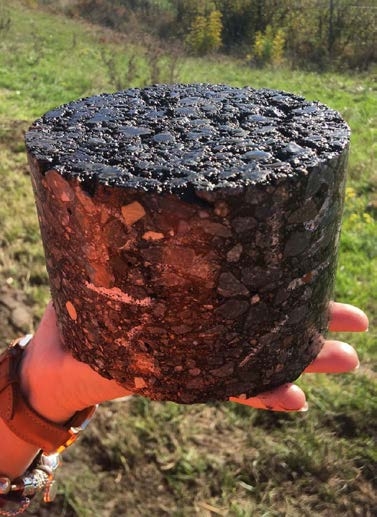
APRR has begun testing a range of low-carbon asphalt alternatives that may reduce the reliance on fossil-fuel derived bitumen in road surfacing. Ongoing operational testing continues of Biophalt®, a plant-based asphalt, as well as Optimised Rolling Resistant Asphalt (ORRA), a low-rolling resistance asphalt to help improve vehicle fuel efficiency. ORRA has been used across a two kilometre area on the A49, and its performance is being monitored for three years. An asphalt with plant-based binder, Vegeroad,is being tested on the A48 and A43. Asphalt-treated sand, as wearing course to limit cracking, was also used on the A6 Beaune in 2024 with 30% of reclaimed asphalt pavement (RAP); its performance will also be monitored for three years.